
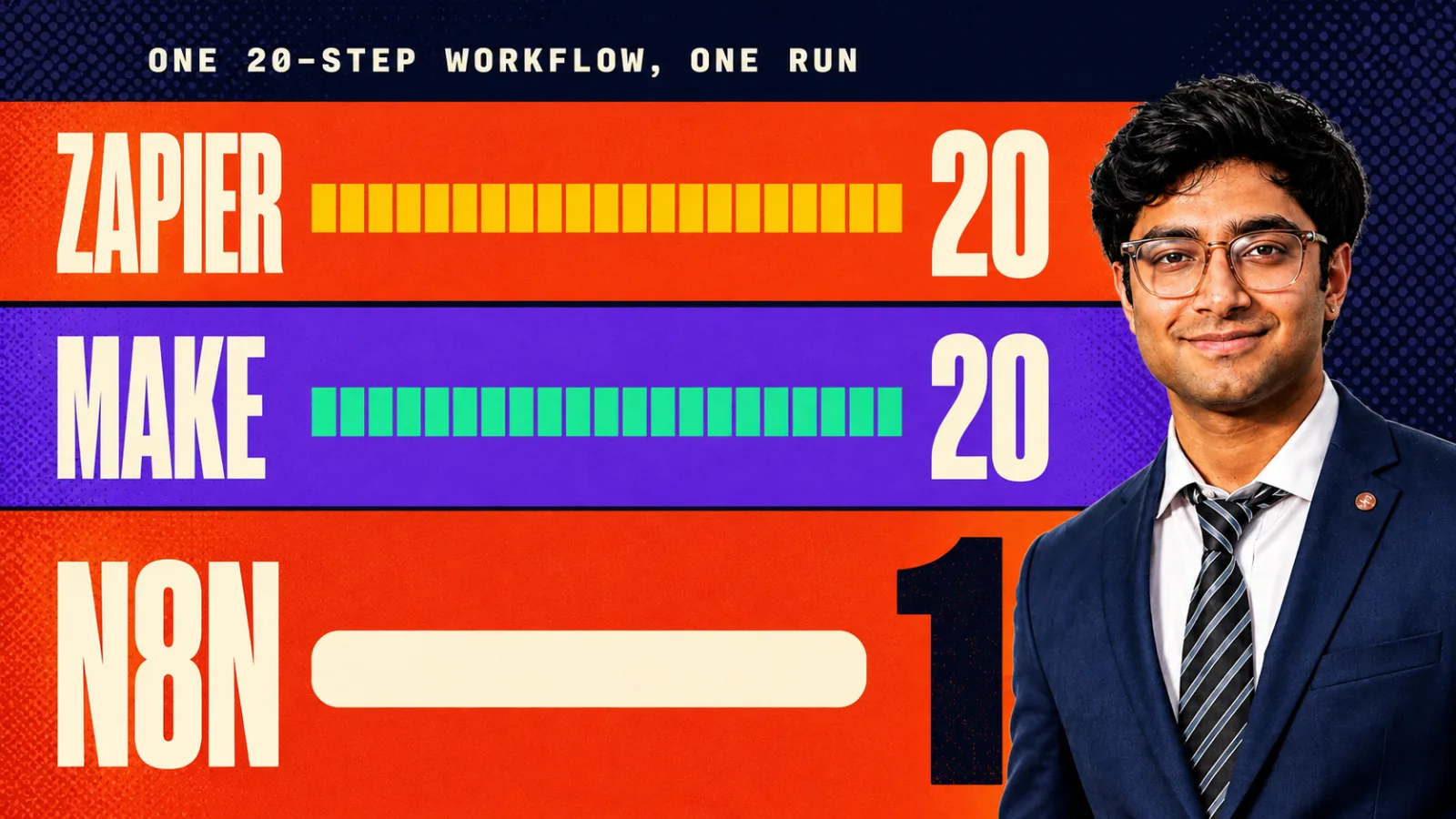
Your automation bill was fine at ten workflows. Then someone built an AI agent.
Now the platform that cost you twenty dollars a month wants five hundred, and nobody can explain exactly why. The workflow did not get more popular. It got more steps.
That is the whole story, and it is invisible on every pricing page. Zapier, Make and n8n charge for three different things, and the difference between them is not a discount. It is a multiplier, and it scales with how complicated your workflow is.
Here is the arithmetic on a 20-step AI agent workflow, using each platform's published prices as of August 2026.
What each platform actually charges for
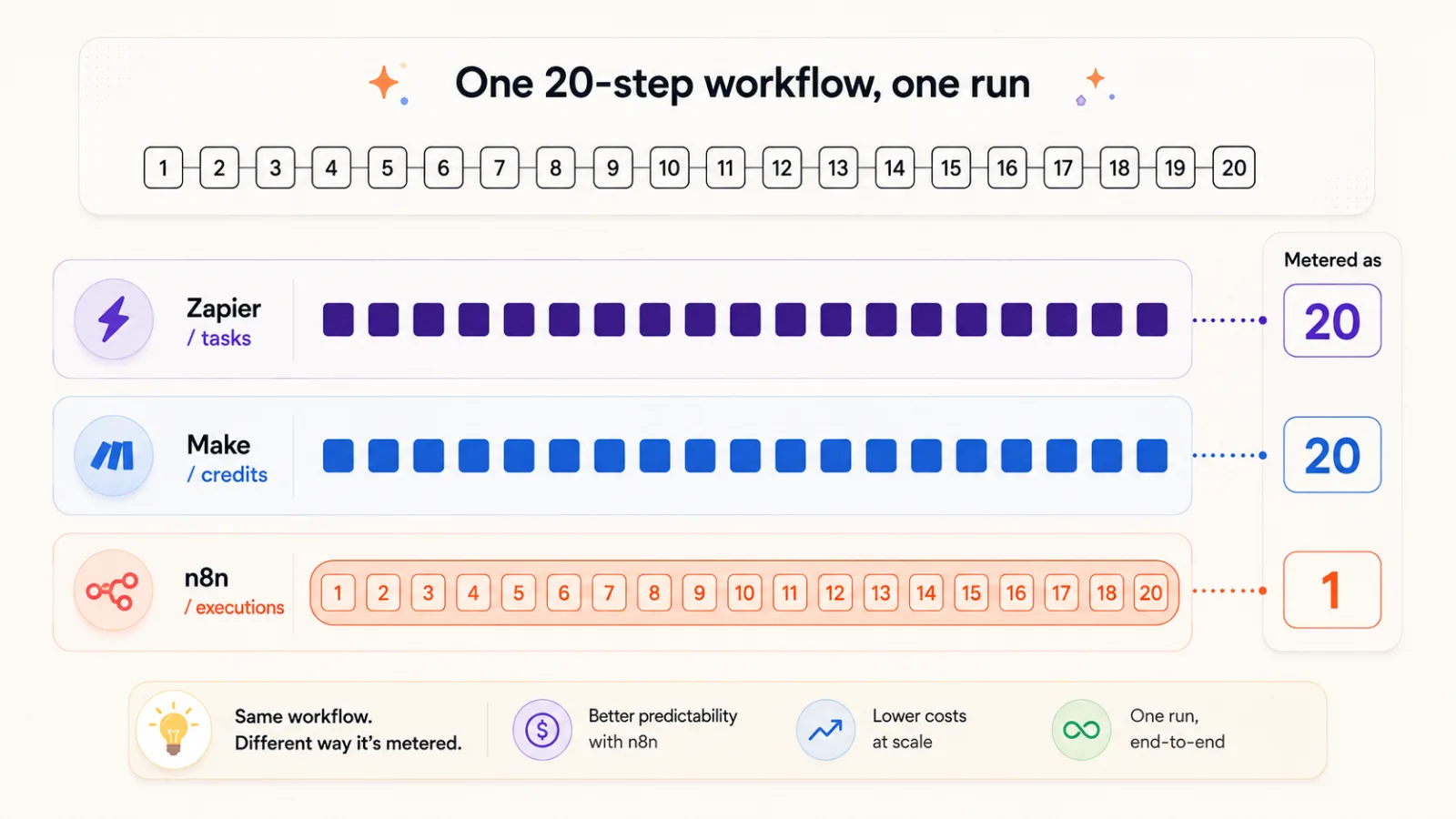
Zapier bills per task, which is one action step. Make bills per credit, which is one module action. n8n bills per execution, which is one entire workflow run regardless of how many steps sit inside it. Same work, three units, and they are not the same size.
n8n's documentation is explicit about this:
An execution is a single run of your entire workflow. It doesn't matter how many steps are in the workflow or how much data it processes.
Make's pricing page states that each module action in a scenario counts as one credit. Worth noting if you are working from an older comparison: Make now meters in credits rather than the operations it used to bill, so any article still counting operations is describing a system that changed.
Zapier counts each successful action step as a task. The trigger itself is free, so a 20-step Zap costs roughly 19 to 20 tasks per run depending on how many filters short-circuit.
A 20-step workflow is one execution on n8n and twenty billable units everywhere else. That single sentence explains most of the price gap you are looking at.
What one run of a 20-step workflow costs
The unit difference compounds into real money fast. All prices below are the published rates in August 2026, at annual billing where the platform offers it.
| Platform | Billing unit | One run of a 20-step workflow | Entry paid plan | Runs per month at that price | Verdict |
|---|---|---|---|---|---|
| Zapier | Task, one action step | ~20 tasks | $49/mo for 2,000 tasks | 100 | Easiest start, worst scaling |
| Make | Credit, one module action | ~20 credits | $9/mo for 5,000 credits | 250 | Cheapest of the two hosted meters |
| n8n Cloud | Execution, one whole run | 1 execution | EUR 20/mo for 2,500 executions | 2,500 | Best value without running servers |
| n8n self-hosted | None, you pay for the server | 1 execution | ~$6 to $12/mo VPS | Unlimited | Cheapest if someone can run a box |
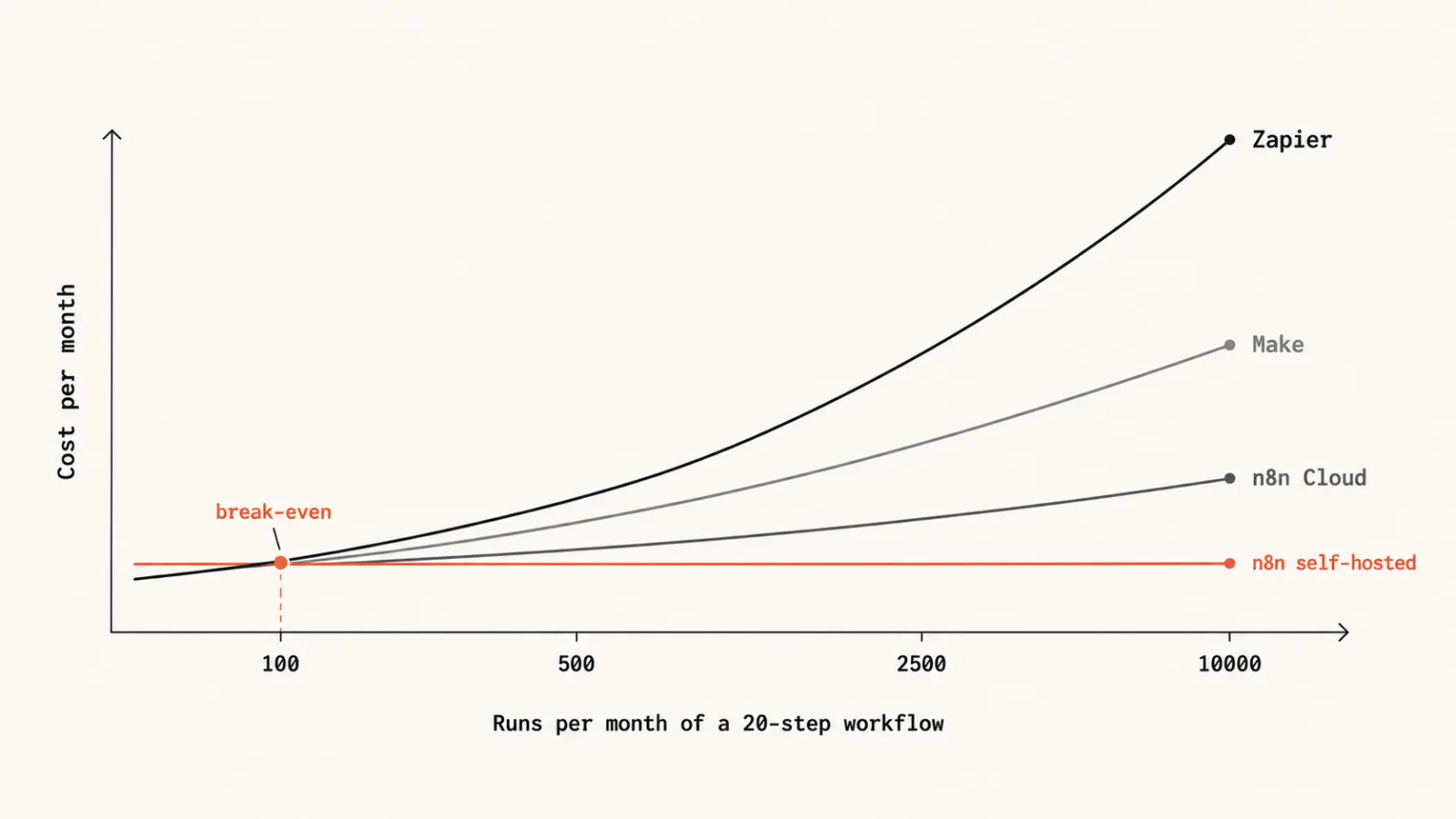
Read the fifth column again. The same EUR 20 that buys 2,500 runs of that workflow on n8n buys 100 runs on Zapier's $49 plan. That is not a rounding difference.
Note the currency mix is real, not sloppy: n8n prices in euros, Zapier and Make in dollars. We have not converted, because the conversion moves and the ratio does not.
Where each free tier actually runs out
Free plans die faster than the marketing suggests once a workflow has real steps in it.
- Zapier free: five runs a month. 100 tasks divided by 20. In practice you get zero, because the free plan caps you at two-step Zaps, so a 20-step agent cannot be built there at all.
- Make free: fifty runs a month. 1,000 credits divided by 20. The free tier also enforces a 15-minute minimum between runs and a maximum of two active scenarios.
- n8n Cloud Starter: 2,500 runs a month for EUR 20. There is no free forever cloud tier, only a trial.
- n8n self-hosted: unlimited. The Community Edition is free to run and the ceiling is your server.
If you are testing an AI agent that fires on every inbound email, fifty runs is a slow Tuesday.
Free tiers are sized for demos, not for pilots. You will hit the ceiling during the week you are trying to decide whether the thing works.
Does n8n 2.0 change the answer for AI agents
Yes, and this is the part most comparisons written before 2026 get wrong. n8n 2.0 shipped in January 2026 with native LangChain support and roughly 70 AI nodes, which moves agents, chains, tools and retrievers onto the visual canvas as first-class nodes.
The practical effect is about where the agent logic lives. Before, an agent meant writing LangChain in Python somewhere else and calling it from your automation tool, which left you maintaining two systems and debugging across the seam. Now the retriever and the tool-calling loop are nodes next to the Slack node.
That matters for cost as well as architecture. An agent that loops has a variable number of steps per run. On a per-step meter, a variable step count means a variable bill, and you cannot forecast it. On a per-execution meter, a loop that runs three times and a loop that runs thirty both cost one execution.
We wrote about the framework layer underneath this in Claude Agent SDK vs LangGraph vs OpenAI Agents SDK, which is the decision you make after you have decided where the agent runs.
On a per-step meter, an agent that loops is a bill you cannot forecast. That is the real argument for per-execution pricing, not the headline rate.
What self-hosting actually costs
The server is the cheap part. A DigitalOcean droplet is $6 a month for 1 GiB of RAM and $12 for 2 GiB, and 2 GiB is a sensible floor once AI nodes are in play.
The licence permits this. n8n ships under the Sustainable Use License, which states:
You may use or modify the software only for your own internal business purposes or for non-commercial or personal use.
Internal business use is explicitly allowed at no cost. What is not allowed is selling it on: distributing n8n as a paid product or offering it as a service to others needs the separate enterprise licence. If you are automating your own company's work, you are inside the terms. If you are planning to resell automation as a hosted product to clients, read the licence properly first.
Here is the part the cost comparisons leave out. Self-hosting moves spend from a subscription line to an engineering line. Someone has to own upgrades, backups, the database behind it, and the 2am failure when a queue backs up. At a 5-person company that someone is usually the founder. At a 50-person company it is a platform engineer who already has a job.
So which one should you pick
Pick on your constraint, not on the headline price.
Choose Zapier if your workflows are short and your team is not technical. Two to five steps, no loops, and people in marketing or ops building their own automations without asking anyone. Zapier's app coverage is the widest of the three and its editor asks the least of you. You are paying for that, and at short workflows the per-task meter barely bites.
Choose Make if you want visual complexity without running servers. Branching, iterators and error handlers on a meter that is cheaper per unit than Zapier's, with a real free tier you can prototype on.
Choose n8n Cloud if your workflows have real step counts and you do not want a server. This is where most 5 to 50 person teams doing AI work land. Per-execution billing removes the step-count anxiety entirely, and you still get someone else running the infrastructure.
Choose self-hosted n8n if you have someone who can own a server, or if data cannot leave your infrastructure. The second reason is often the real one. Regulated data, client credentials and anything under an NDA are easier to defend when the workflow engine is inside your own network.
Common mistakes
Comparing sticker prices instead of unit prices. EUR 20 against $49 tells you nothing until you know that one buys executions and the other buys tasks. Work out your step count first, then multiply.
Forgetting that agents have variable step counts. A deterministic 20-step workflow is easy to forecast. An agent that decides how many tool calls it needs is not. If you are on a per-step meter, model your worst case, not your average.
Self-hosting to save $50 a month. If the subscription you are escaping costs less than a few hours of your time each month, you have not saved anything. The maths only works when the bill is large or the data cannot move.
Treating the free tier as a pilot. Five runs on Zapier or fifty on Make will not tell you whether the workflow holds up. Testing an agent properly means firing it hundreds of times against messy real inputs, which is exactly what free tiers are shaped to prevent.
Ignoring the migration cost. Workflows do not port between these platforms. Moving 30 live automations is a project, not an afternoon, and that cost belongs in the comparison before you commit.
Key takeaways
- Zapier bills per action step, Make per module action, and n8n per whole workflow run, so a 20-step workflow costs about 20 billable units on the first two and exactly 1 on n8n.
- At published August 2026 prices, EUR 20 on n8n Cloud buys 2,500 runs of a 20-step workflow while $49 on Zapier buys about 100.
- Zapier's free plan cannot run a 20-step workflow at all, because it caps you at two steps.
- n8n 2.0 shipped native LangChain support and around 70 AI nodes in January 2026, which is why the agent conversation now includes it.
- Per-execution billing matters most for agents, because an agent's step count varies per run and a per-step bill cannot be forecast.
- Self-hosted n8n is free to run for internal business use under the Sustainable Use License, on a server costing roughly $6 to $12 a month.
- Self-hosting trades a subscription for an engineering responsibility. That trade is worth it when the bill is large or the data cannot leave, and not otherwise.
If you want the workflow built and handed over rather than evaluated, that is what we do at workflow automation. We will tell you which of these three we would put it on, including when the answer is the one you are already paying for.